
In the development of power electronics systems, in some instances, especially if a design change is required in the development of a product after the production mechanical design has been developed (towards the end of the A sample, for example), it may be necessary to revise the design of a wound component. This is occasionally necessary to try to ameliorate a thermal management problem.
In this case the mechanical design is now driving the system level electronic design which is not generally desirable.
It may be necessary in this case for the systems engineer or wound component designer to accept the envelope they’re presented with and “make the best of it”. Even if they know that making the best of it isn’t going to work out well in the end, it is sometimes necessary to try anyway in order to convince a client that there is no alternative to revising the mechanical design in order ultimately allow the electrical and thermal performance requirements to be met, however costly and inconvenient this may initially appear to be.
Our problem is then how to get ‘the best’ out of the space available…
Our chief magnetic designer bear has developed some analysis from first principles which provides an algebraic expression for the optimum inner core dimension (core thickness) given a hard outer width, height and depth restriction for a UU shaped core.
We gave him a large fish and half a pot of honey in return… he seemed happy with the exchange.
In the diagram below we’re looking for the value of Vt which gives the biggest core geometry coefficient, Kg given a specified W, H and D.
Ht and Vt are taken to be equal to each-other as the bear got very grumpy when we asked for them to be seperated. We’re calling them the “Core thickness”.

In the zip file below:
- PTC MathCad Prime 6 document for calculation of a particular Kg for given core dimensions and fill factor.
- wxMaxima document in which the algebraic optimum expression for Vt is derived.
- PDF print out of the above wxMaxima analysis
- Octave/Matlab script (.m file) for numerical calculation of the optimum value of Vt given W, H, D and Ku.
- MS Excel sheet which can be used to plot a curve of Kg for a given core as a function of Vt. W, H, D and Ku are fixed, Vt is swept and Kg vs Vt is plotted.
Download UU Core Optimisation Pack
To demonstrate the results we consider the UU 93/76/20 core shape (EPCOS Ferrites and Accessories Databook 2017 pp 610). W = 93 mm, H = 2 x 76 mm, D = 20 mm. and Vt = 28 mm but, that’s what we’re working towards…
The MS Excel sheet is used to show the relationship between core thickness and Kg
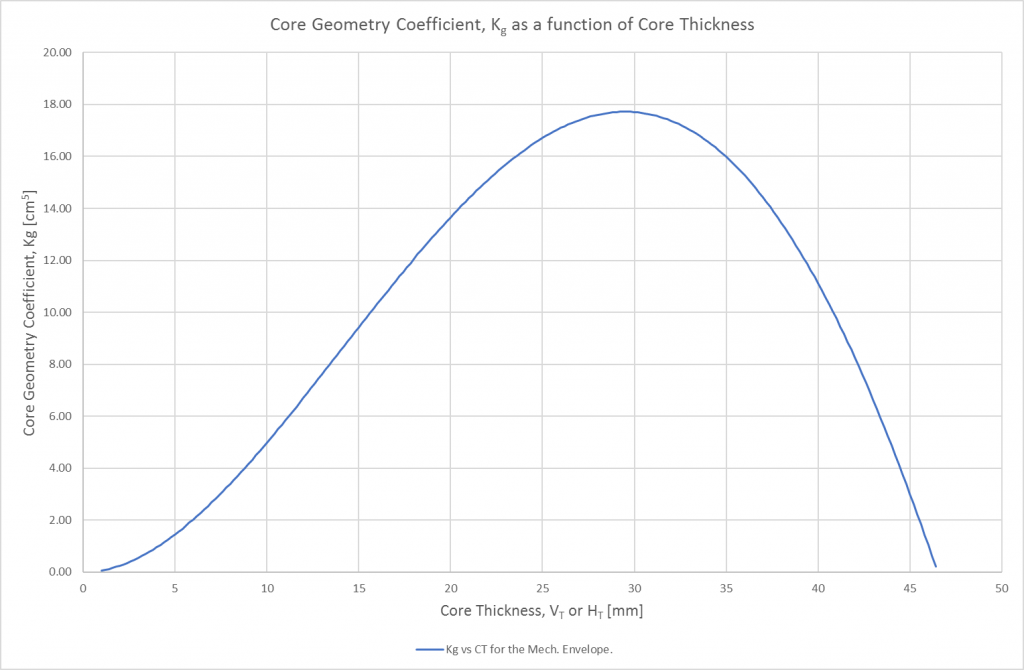
The maxima is a Kg of about 17.6 cm5 at a core thickness of just less than 30 mm. This is in good agreement with the manufacturer’s choice of 28 mm.
The Matlab/Octave script returns the numerical value directly Vt(opt) = 29.508 mm.
The discrepancy between the catalogue core dimension and the calculated optimum is most likely to do with the mean length per turn calculation. It is common to include some room for the coil former (2 mm or so). To simplify the process this has been neglected.
Having made our assessment of the optimum UU core for the given mechanical envelope, we can perform the winding design and send the design documents to our favorite build to print house for the core to be machined (unless we’re lucky and find a standard core which is perfect) and for the coils to be wound.
Get in touch if you need support with wound component or system level design/architecture or if you find any mistakes.
James (Chief Bear)
p.s. When assessing a design of unknown origin, it’s usually fairly easy to tell based on a rough I2R calculation for the low frequency copper loss and the free air temperature rise equations given by McLyman and Kazimierczuk if the thermals are going to go in your favor or not. This is even true when the device will be bonded to a liquid cooled plate. Allowance must be made for the enhanced cooling but, the heat still has to get out of the winding, probably through the core, and into the cold plate… If it seems too good to be true it almost certainly is!