
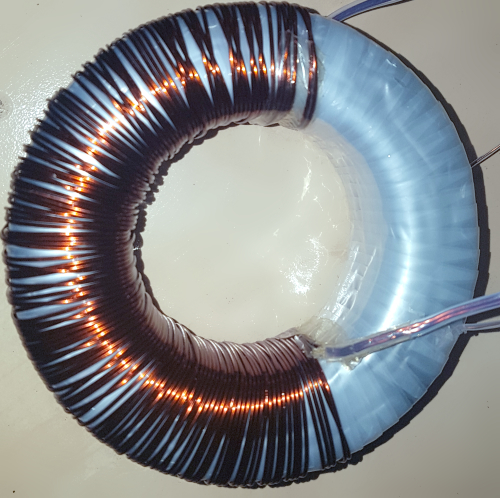
If you’re in the throws of a PhD at the moment you may be feeling like you have no idea how it’s going to end and you may also be wondering if your supervisor really knows where it’s going because you sure don’t. Chances are they don’t either.
I was once a PhD student who wondered this. Fortunately a more experienced PhD student told me in no uncertain terms that there was no plan and I had to plan how it would end or be stuck forever.
Much later, I was the one supervising the PhDs. I did plan them a bit. Probably not as much as my students would have imagined though. This is a little insight into what that planning might have looked like.
Over the last few days I’ve been thinking about losses in ferrite materials used in magnetic components. The general state of play is that all the major manufacturers have different amounts and quality of data and it’s all presented differently. None of them really give out their experimental methods. The academic literature is much the same. Loads of papers (it’s a very old problem). Everyone has their own method and explanation and it’s very hard to compare them fairly. Hard to make much progress if we want to be sure we’re on “firm ground”.
So I wrote out what I wanted… and it turns out that what I want is a PhD student – only problem is I’m not an academic any more.
Therefore, for your amusement, this is the amount of planning I would usually put into a PhD proposal before firing it at some colleagues for their opinion. If you’re doing a PhD now and your professor is anything like I was then your future probably rests on one page of A4 of a very similar structure to this:
Possible PhD on Ferrite Core Loss
Write to TDK and ask them if they would consider (part) funding it.
Practical
1) Integrating calorimeter to measure total energy lost from the core + windings. May have to make one that is suitable. Effectively a small oil filled pot not much larger than the torriod to be tested. The oil filled pot is surrounded by a metal block whose temperature is kept constant using a control loop and Peltier devices. The total energy lost to the oil + block during the experiment is the sum of the core and copper losses. Need to have good calibration technique. Consider using Peltier devices to raise temperature of a known quantity of pure water by a known temperature and measure the total energy input. This should yield the relationship between the energy into the calorimeter to maintain isothermal conditions and the energy added to or removed from the sample (pure water specific heat capacity is well known). May need a second calorimeter just running next to the experiment to try to account for background fluctuations in the block temperature and energy lost to the room from the block while maintaining a specific temperature above/below the room temp.
2) Excitation waveform set to investigate the relationship between pk B field, RMS B field peak dB/dt etc. and the core losses.
3) Wide band power amplifier to provide current/voltage through/across coil over a range of frequencies with arbitrary waveform shape. Suitable waveform generator to provide arbitrary waveforms.
4) Estimate copper losses of coil without core by analytical means and by FE analysis.
5) Run coil in calorimeter without core to measure copper losses (measure I and V too, Tek wide band clamp for I).
Compare 4 and 5 for consistency. Obtain consistency before moving on.
6) Run coil in calorimeter with core. Difference between 5 and 6 is the core loss. Plot against everything of note (f,B,T). For common power ferrites f = 1 kHz – 1 MHz, B = 1mT – 400 mT, T = -40°C – 150°C for as many materials as possible.
Instantaneous B can be inferred using a, low number of turns, sense coil.
Theoretical
Seek phenomenological explanation for results based on physical modelling (as opposed to parameter based or behavioural modelling) (lots of work here!)
Seek a set of parameters which yield waveform shape independent results. If it transpires this is impossible, use Fourier decomposition to provide the loss due to each harmonic of a series.
Publications
Publish 3 IEEE papers:
- One on the method and some Ferrite data with behavioural / parameter based explanation
- One on the phenomenological explanation
- One on the application of the technique to nanocrystaline materials.
Thesis
Background (core loss phenomenology and modelling methods), Experimental methods and equipment design, chapter on ferrites measurement results, parameter fitting and phenomenological explanations, chapter on nanocrystalline results and phenomenological explanation, conclusion.
Go to pub.
That’s it. PhD planned.